Factories > Overview
Warp Factories overview
Configure development workflows on Warp Factories, connect your repositories and tools, and measure the results.
Warp Factories is open, flexible infrastructure for building your own software factory. Define your workflows as code, connect them to your repositories and tools, and use evaluation and benchmarks to measure results and compare changes.
Your factory assigns configured agents, called workers, to your team’s development tasks. For example, it can take an issue from Slack, GitHub, Linear, or Jira, investigate it, implement a change, and return a pull request for review. You define how the work moves between stages and where people need to make decisions.
Before sending sensitive work, review ZDR, data collection, and storage for factory runs.
What a factory does
Section titled “What a factory does”A factory can work through a backlog of tasks, fix defects reported in a support channel, or review incoming pull requests across several repositories.
Start with one task, such as reviewing a pull request. You choose the review criteria. The worker returns findings for you to review, and you decide what to address and whether to merge. Test a small configuration change before expanding its workload.
The parts of a factory
Section titled “The parts of a factory”Work items
Section titled “Work items”A work item is one request the factory acts on. This can be an issue, a support thread, a pull request, or a scheduled job. It keeps its source context from intake to handoff, however many workers contribute along the way.
Foreman and factory workers
Section titled “Foreman and factory workers”The foreman coordinates the top-level workflow: it sends requests to the assigned workers, relays questions and your answers, and returns results for your review. It continues the same worker conversations for follow-ups. See About factory workers for their roles, and Configuring factory workers to change their models, harnesses, and instructions.
Setup gives the foreman the same handle as the factory, so payments is the factory and @payments reaches its foreman from Slack or Linear. See Foreman name.
Stages and checkpoints
Section titled “Stages and checkpoints”Factory workers run the stages of the software development lifecycle. The default Blueprint covers triage, planning, implementation, and review.
A Blueprint defines the workflow’s stages, what happens in each stage, who does the work, and when a person needs to make a decision. To change a review loop or approval requirement, edit the Blueprint. Configure worker resources and shared behavior in the worker definitions.
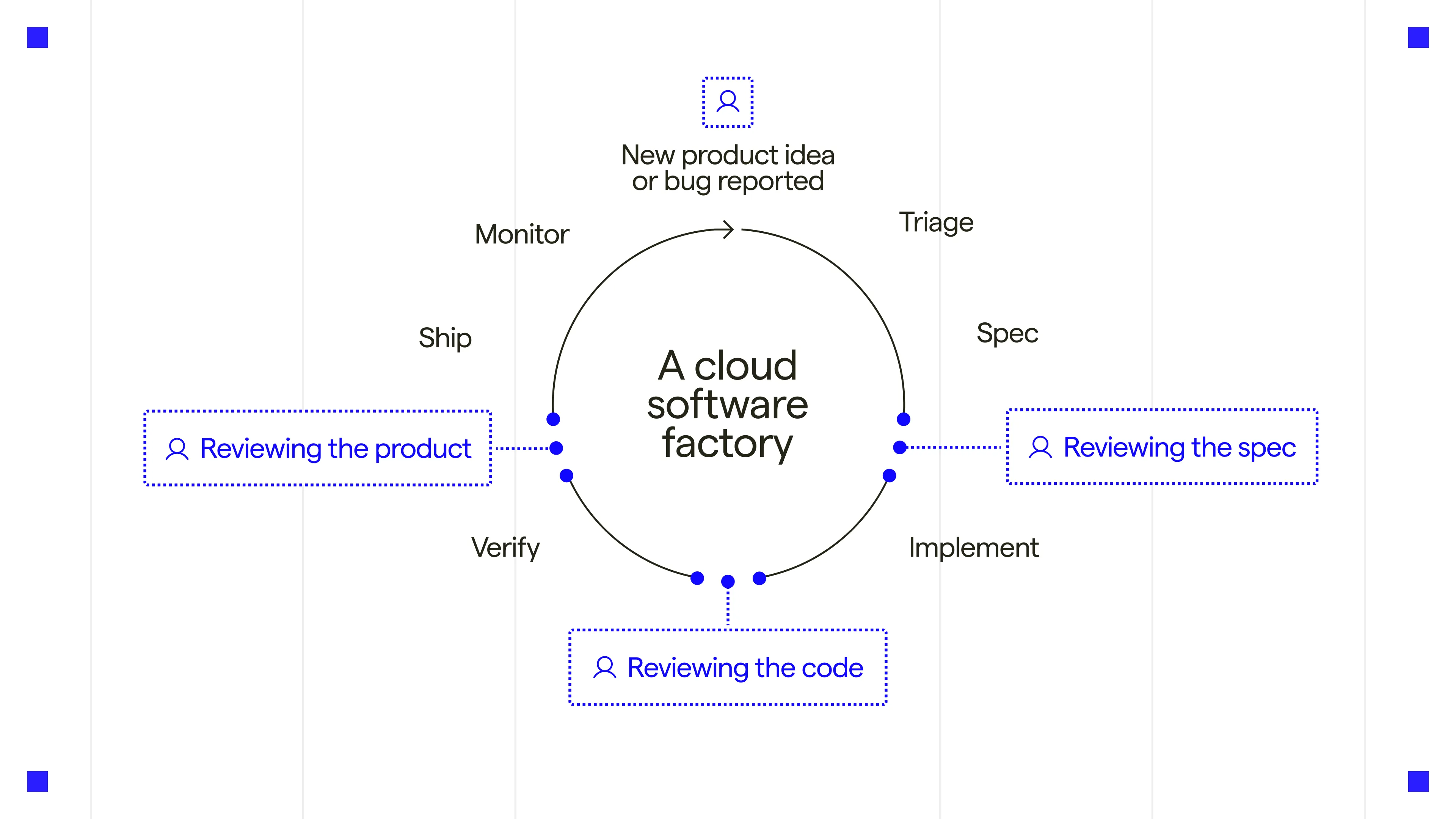
The coordinating worker follows the Blueprint’s transitions to skip unnecessary stages or return work for revisions. A plan-review gate waits for your answer before the workflow continues. Workflow policy does not grant merge access; repository permissions and branch protection control approval and merging. See How Warp Factories work.
Factory definition
Section titled “Factory definition”A factory’s repositories, workers, automations, runners, skills, and MCP servers are declared in definition files hosted by Warp or in a GitHub repository your team owns. Changes to a definition hosted by GitHub go through pull request review like any other code. See definitions as code.
Work sources
Section titled “Work sources”Connect Slack, Microsoft Teams, GitHub, GitLab, Azure DevOps, Linear, and Jira through factory integrations. Results return to the thread, issue, or pull request where work began. Use custom webhooks or factory endpoints for other systems, and automations for scheduled work.
The Factory MCP lets a local coding agent send work to a factory, take it over locally, and hand it back.
Execution
Section titled “Execution”Every worker run in a factory is an ordinary cloud agent run on the Automation Platform. Runs execute on Warp-hosted compute by default; Enterprise teams can keep checkout and execution on their own infrastructure with managed self-hosting. See infrastructure and security for runners, inference, and credential boundaries.
Evaluate and improve factory work
Section titled “Evaluate and improve factory work”Use the factory dashboard to inspect PR activity, autonomy, cycle time, and cost. To evaluate and improve the work:
- Scorers - Classify runs against your criteria.
- Benchmarks - Compare configurations on the same tasks.
- Self-improvement - Propose changes for review.
See measure and improve for definitions and limitations.
Sizing a factory
Section titled “Sizing a factory”Group the repositories that ship together into one factory, and keep separate products in separate factories. For example:
- One factory for your main application
- One factory for your marketing site
- One factory for your data pipelines
Don’t split the same repositories across factories by team or task, such as frontend and platform. Add custom workers and skills to specialize instead.
Related pages
Section titled “Related pages”- Warp Factories quickstart - Create a factory and send its first work item.
- How Warp Factories work - The work-item lifecycle, stage by stage.
- About factory workers - Understand default worker roles
- Configuring factory workers - Choose models, harnesses, and instructions
- Multi-agent orchestration - Fan out ad-hoc parent and child agents outside a standing factory
- Definitions as code - The definition file format, with working examples in warp-factory-examples.
- Transitioning from Oz - Assess an existing web app, CLI, SDK, or API workflow.
- Get started with the Warp team - Get help choosing and setting up a workflow.